Inge Lehmann Symposium, Copenhagen
 Old Members’ Trust Graduate Conference and Academic Travel Fund report – Justin Leung (2018. Earth Sciences)
Thank you to the Old Members’ Trust Graduate Conference and Academic Travel Fund for supporting my attendance of the Inge Lehmann Symposium in Copenhagen, Denmark in January, 2025. This symposium consisted of around 100 solid Earth geophysics researchers, spanning early career researchers all the way to senior researchers, to discuss state-of-the-art and future research in the Earth’s interior.
The symposium was hosted in honour of Inge Lehmann, who was a Danish seismologist and a pioneer in the field of Earth Sciences. Her most notable discovery is the detection of the Earth’s solid inner core in 1936. When studying a large earthquake near New Zealand in 1929, she observed that a few P-waves, which should have been deflected by the core, were recorded in Russian cities that would have been impossible to observe if the entire core was liquid. To explain this observation, Lehmann theorized that these waves must have travelled into the core and reflected off some boundary, leading her to hypothesize in her 1936 paper that Earth’s core consisted of not one, but two layers: a liquid outer core, and a solid inner core.
In this symposium, I had the opportunity to listen to inspiring talks and leading research across all depths and regions of the planet, including seismic imaging for CO2 storage, monitoring Earthquake swarms in Greenland, improving seismic techniques to quantify uncertainties, utilizing seismic scattering data to improve our understanding of Earth structure, and the domination of a planetary-scale gyre in the core as observed from magnetic field observations. Speaking with the different attendees of the symposium and learning about their research, I once again appreciate the complexity of the interior of our planet, and the large scope of fascinating and interdisciplinary problems that we face when investigating the interior of our planet.
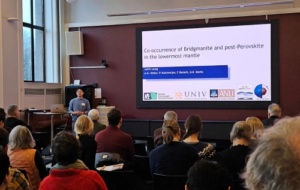
Additionally, I had the opportunity to give my first international talk on my research over the past year on constraining the composition and mineralogy in the lowermost mantle. It was a rewarding experience to present my research to international senior researchers in the solid Earth community, and it also encouraging to hear their constructive comments and positive support of my work. This work has now been submitted as a manuscript titled ‘Quantitative assessment of tomographic proxies for lowermost mantle composition and mineralogy’ in Physics of the Earth and Planetary Interiors.
This conference has, overall, been an invaluable experience for me, in terms of making valuable connections with other academics in the field of solid Earth physics and to share my work with the community. I would once again like to thank the Old Members’ Trust Graduate Conference and Academic Travel Fund for supporting my attendance.
Published: 11 April 2025
Explore Univ on social media